
 Speak with an experienced advisor!
 Skin Cancer and Life Insurance Prices
Skin cancer is the most common form of cancer. One out of six Americans will develop the condition during their lifetime and approximately 700,000 Americans are diagnosed with it annually. In the United States, 1 person out of every 65 will be diagnosed with melanoma, the most deadly form of skin cancer. The risk of developing melanoma increases with age, but the disease frequently affects young healthy people. Melanoma is the number one cause of cancer death in women aged 25 – 30. Skin cancers detected early in their development have the best outcomes and will receive the most favorable rate consideration from insurers.
Skin Cancer and You
Skin cancer tends to occur on areas of the skin that are regularly exposed to sunlight or other ultraviolet radiation. They are often diagnosed after the age of forty. People with fair skin, red or blonde hair, and light eyes are most likely to develop skin cancer, however, even individuals with dark skin, hair, and eyes must be proactive in protecting themselves against exposure to sunlight or other ultraviolet radiation. The risk of developing skin cancer is elevated if a person had severe, blistering sunburns in childhood or before the age of twenty. Exposure to strong sunlight as a teenager also increases a person’s risk of developing skin cancer. A family history of skin cancer, melanoma, atypical moles or multiple birthmarks puts a person at risk and freckles, once considered beauty marks, are danger signals if they appear on the upper back.
Other related medical conditions (or medical terminology) include Skin Cancer, Basel Cell Carcinoma, Squamous Cell Cancer, Melanoma. Read below for more information about skin cancer and receiving a life insurance quote from a life insurance specialist.
The ABCs of Skin Cancers
Individuals should check their entire bodies for suspicious growths. Using a mirror or with the help of someone else, a person’s back, shoulders, and other hard-to-see areas of the body should be checked for signs of skin cancer. Skin cancer comes in all shapes, sizes and varied appearances. They can be small, shiny, waxy, scaly, rough, firm and red, crusty or bleeding. The ABCs of skin cancer detection are:
- Asymmetry: one half of the abnormal skin area is different than the other half
- Borders: moles or growths with irregular borders
- Color: variation in color from one area to another with shades of tan, brown, or black (sometimes white, red, blue)
- Diameter: lesions that are larger than 6 mm in size, or the approximately the diameter of a pencil erase
All Skin Cancers Are Not Alike
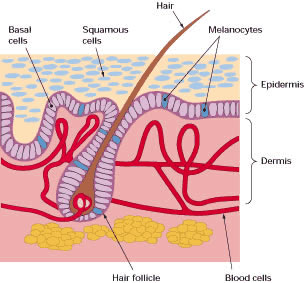
Skin cancer is a term that identifies an uncontrolled growth of abnormal skin cells. The body’s outer layer of skin, the epidermis, is made up of different types of cells. Skin cancers are broadly classified by the types of epidermal cells involved.
Actinic keratosis is considered a precancerous lesion and approximately ten percent will evolve into squamous cell carcinomas.
Basal cell carcinomas develop from abnormal growth of cells in the lowest layer of the epidermis. It can present as a small, slightly raised or flat skin nodule, pearly or waxy in appearance; it can be white, light pink, flesh-colored or brown in color. It often masquerades as a sore that bleeds easily; a sore with a sunken center or as a wound that does not heal. It can also appear as a scar in an area that has not been injured. Irregular blood vessels may appear in or around basal cell carcinomas. Basal cell is the most common form of skin cancer and does not typically spread. If left untreated, it may grow into surrounding areas and nearby tissues and bone.
Squamous cell carcinoma involves changes in the cells found in the epithelial layer (the surface layer) of the skin. It may appear on the face, ears, neck, hands, or arms as a growing bump that has a rough, scaly surface and flat reddish patch, but they may occur on other areas of the body as well. It has a greater likelihood of spreading than basal cell carcinomas, but still may be relatively slow-growing. It can spread (metastasize) to other locations, including internal organs.
Melanoma is a malignant tumor that originates in melanocytes, the cells which produce the pigment melanin, that color our skin, hair, and eyes. It is the rarest and most deadly form of all skin cancers and can spread rapidly. It is less common than other types of skin cancer, but the incidence of melanoma is steadily increasing. Although it is the leading cause of death from skin disease, it can be treated and cured if detected early.
Melanoma may appear on normal skin, or it may begin at a mole or other area that has changed in appearance. Melanoma can also affect the iris, the colored part, of the eye. Some moles, present from birth, may develop into melanomas. There are four types of melanomas:
- Superficial spreading melanoma is the most common type of melanoma. It is usually flat and irregular in shape and color, with varying shades of black and brown. It may occur at any age or body site, and is most common in Caucasians.
- Nodular melanoma usually starts as a raised area that is dark blackish-blue or bluish-red, although some are without color.
- Lentigo maligna melanoma usually occurs in the elderly. It is most common in sun-damaged skin on the face, neck, and arms. The abnormal skin areas are usually large, flat, and tan with intermixed areas of brown.
- Acral lentiginous melanoma is the least common form of melanoma. It usually occurs on the palms, soles, or under the nails and is more common in African Americans.
All skin cancers are classified as either melanomas or nonmelanomas. Basal and squamous cell carcinomas are the most common nonmelanomas. Other nonmelanomas include Kaposi’s sarcoma, Merkel cell carcinoma and cutaneous lymphonma.
Treatment Options for Skin Cancer
If skin cancer is suspected, a piece of skin will be removed from the area so that is can be examined under a microscope. This is called a skin biopsy and is done to confirm the diagnosis and type of skin cancer. Once the type of skin cancer is identified, treatment will vary depending on the size, depth, and location of the cancer.
Basal cell and squamous cell carcinomas may be removed using several techniques. During excision, the physician cuts the lesion out and stitches the skin back together while curettage and electrodesiccation involves scraping away the cancer cells and using electricity to kill any remaining cancer cells. Mohs surgery removes a lesion by layers. As skin is removed during Mohs, it is immediately looked at it under a microscope to check for cancerous cells. Skin samples continue to be removed and examined until cancer cells are no longer evident in the sample. Cryosurgery freezes and kills the cancer cells.
Melanomas are usually removed surgically as they tend to penetrate more deeply into the skin than basal cell or squamous cell carcinomas. The tumor is then categorized using two systems: the Clark’s level describes the how deep the tumor has invaded the skin and the Breslow Scale measures the vertical thickness of the tumor. The Breslow Scale is used to determine the likeliness of metastasis.
Radiation may be used if the cancer has spread to organs, lymph nodes or on tumors that can’t be treated with surgery.
Squamous cell tumors have a ninety-five percent cure rate if removed promptly. Basal cell cancers have approximately a one percent chance of recurrence after Mohs surgery and a ten percent chance following other forms of treatment. Melanomas that are surgically removed are considered “cured”, however, only time will determine if all cancer was successfully removed during the procedure. With skin cancer, new tumors and reoccurrences are possible, so regular skin examinations by your health care provider are recommended following treatment for any type of skin cancer.
Different Skin Cancers, Different Insurance Issues
All skin cancers are not alike, nor are life insurance policies for those affected with skin cancer. Basal cell carcinomas do not typically pose a concern to insurers as they review a life insurance application, except in applications where multiple basal cell carcinomas have reoccurred, particularly if the applicant is young. Due to the concern of metastasis, individuals with squamous cell carcinomas should be prepared to supply specific, detailed information about their condition. Insurers will want to know the number of lesions, the aggressiveness of the cancer cells as reviewed in the pathology report and the staging of the cells before they make their decisions. Policies are usually issued to individuals with squamous cell carcinomas, sometimes with extra flat rates for several years following the last date of treatment, although occasionally applications are declined when metastasis is evident. Melanomas, by virtue of their deadly nature, cause insurers the most concern. When evaluating applications, insurers will want the Clark level of staging and the Breslow Scale rating of the tumor. As time is the best indicator of cure in the case of melanoma, insurers may postpone their decision for a few years or impose a flat extra rate on approved applications.
How Can MEG Financial Help?
At MEG Financial, we have worked with many individuals across the country that have had related histories and have helped many obtain fairly priced life insurance. A number of these clients previously attempted to buy life insurance elsewhere but were either turned down or asked to pay a significantly higher rate. Our experience helping others with related problems is invaluable to you in identifying the insurance company that will treat you most fairly.
For more specific information or to obtain a custom quote, call MEG Financial today at (877) 583-3955. You may also submit this short form and an independent insurance agent will personally contact you to go over any questions or other concerns.