
 Speak with an experienced advisor!
 Have you been charged an excessive rate or declined for life insurance due to your history of coronary artery disease (CAD)?
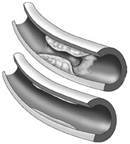 Coronary artery disease, also referred to as coronary heart disease or CAD, is the most common health condition that life insurance companies encounter. Additionally it is one of the leading causes of death in the US affecting both men and women in large numbers. While many life insurance companies are not willing to consider CAD for competitive rates, some companies have a good understanding of its impact on mortality and will be more “open minded” when evaluating this condition. The information below will provide you with general information on coronary artery disease including some facts and statistics as well as its impact on life insurance rates.
Understanding Coronary Artery Disease (CAD)
Coronary artery disease, also known as atherosclerosis or arteriosclerosis, is the result of the narrowing of the arteries that carry oxygen and nutrients to the heart muscle which allow it to pump blood effectively. Partial closure of these arteries can cause angina (chest pains) and complete blockage will lead to a heart attack..
CAD occurs over time and begins with an injury to the inner wall of an artery potentially caused by high blood pressure, elevated cholesterol, diabetes and smoking among other factors. At the place of injury, fatty deposits called plaque begin to collect and harden. As the fatty deposits accumulate, they slowly narrow the artery and restrict the flow of blood to your heart. If the plaque buildup ruptures, the body’s response is to send blood cells called platelets to the site to try to repair the artery. These platelets can clot resulting in a blockage which can lead to a potentially fatal a heart attack.
See also, “Arteriosclerosis and Its Impact on Life Insurance Rates”.
Other related medical conditions (or medical terminology) include Coronary Artery Disease, CAD, Heart Disease, Coronary Angioplasty, Atherosclerosis, Coronary Stents, Heart By-Pass Surgery, and Heart Catherization. Learn more information on receiving a term life insurance quote with these medical conditions from our life insurance specialists.
Coronary Artery Disease Statistics and Facts
- Coronary heart disease affected more than 15 million American is 2004, American Heart Association.
- Coronary heart disease caused about 452,300 deaths in 2004 and is the single leading cause of death in America today, American Heart Association.
- This year an estimated 1.2 million Americans will have a new or recurrent coronary attack, American Heart Association.
- Coronary artery disease is the nation’s leading cause of death.
- Every 34 seconds a person in the United States dies from heart disease which results in more than 2,500 Americans die from heart disease each day, Mamashealth.com.
Risk factors for CAD
There are many contributors to coronary artery disease and life insurance companies are especially interested in the presence of these risk factors and how they impact each individual. The good news is that many of the factors associated with CAD are controllable. Following are the most important risk factors in evaluating an individual with coronary artery disease:
- A family history of heart disease,
- Age, the older you are the greater risk of CAD,
- Stress,
- Obesity,
- Smoking or tobacco use,
- High Blood Pressure,
- Poor nutrition,
- Diabetes, and
- Lack of physical activity/exercise.
These risk factors are often present in combination and may lead to even additional problems that may have long term effects adding to an increased risk of CAD. For example, lack of physical exercise and poor diet will lead to obesity which could result in high cholesterol and diabetes. When these risk factors occur in multiples, you stand a much greater risk of developing coronary artery disease. Consequently, you can expect to pay a higher rate for life insurance.
The Impact of Coronary Artery Disease on Life Insurance Rates
Coronary artery disease is the leading cause of death in the US and will therefore be a significant concern for all life insurance companies. When determining your rate for life insurance, companies will be specifically interested in the results of your diagnostic testing. Tests such as exercise stress tests, stress echocardiograms, angiograms, thallium testing and CT scans reveal the existence and significance of CAD. Additionally, the presence of the risk factors listed above and any treatment such as coronary angioplasty or coronary by-pass will be major considerations in determining your rate for life insurance.
Coronary artery disease is best diagnosed through a series of medical tests such as an exercise stress test, stress echocardiogram or an angiogram. The exercise stress test is the simplest test and is useful in determining the likelihood of CAD. If the exercise stress test is abnormal a stress echocardiogram or angiogram can help identify the level of plaque buildup, the percentage of arterial narrowing involved (stenosis) as well as the number of vessels affected. From the insurance company’s perspective, each of these variables will help determine the severity of the condition and its overall threat to mortality. From the physician’s perspective, these results can be used as a barometer for future maintenance as well as an indicator of a potential treatment strategy. See, Life Insurance Underwriting Versus Practical Medicine.
If your exercise stress test shows abnormalities, the severity of your abnormality will determine your actual rate for life insurance. A mildly positive stress test may result in a life insurance health class of standard with an additional 25%-50% extra charge or rating. If the stress test shows moderate to strong abnormalities the rate you can expect may be standard with an extra charge of 75%-100%.
If there is a positive stress test, you will likely do a follow up stress echocardiogram or angiogram. Either of these tests will be more definitive in determining the presence and severity of CAD. A normal stress echocardiogram or angiogram will go a long way to ruling out the presence of CAD and will positively impact the rate you pay for life insurance. In fact, some life insurance companies may give you standard rates if the stress echocardiogram or angiogram is normal.
If the stress echocardiogram or angiogram is abnormal, the level of plaque blockage along with the number of diseased vessels and their locations will be of critical importance in assessing your level of risk. If there is only one vessel involved and the blockage is in a favorable location, surgery such as angioplasty may be an effective solution. Angioplasty is a procedure whereby the artery is reopened by inserting a thin tube (catheter) with a balloon through the vessel and expanding the balloon in the affected area to widen the arterial wall. In some cases, stents are inserted to help prevent arteries from narrowing again in the future. For more information see, Angioplasty and Life Insurance.
If you have had a successful angioplasty procedure and assuming limited risk factors noted above, your life insurance policy will most likely be rated with a small extra charge. With only one or two vessels affected and no other underlying heart issues, you might qualify for life insurance at a standard rate depending on the insurance company but will likely be charged 25% to 50% more than the standard health class. Compliant medical follow up is also mandatory to getting the most favorable rate.
Those with CAD requiring multiple angioplasties with stents or major surgical procedures such as a heart by-pass will pay significantly higher rates for life insurance. A best case scenario in these cases will likely be 50%- 150% more than the standard health rate. This assumes limited risk factors above and compliant medical follow up with a cardiologist.
If you have major CAD with multiple risk factors noted above you may pay rates in excess of 200% more than the standard rate. This includes individuals with several health concerns such as high blood pressure and diabetes along with coronary artery disease. With a combination of health problems, and depending on the stability of your overall health, you may even be declined for life insurance.
In most cases, you may not realize that you have CAD until you experience symptoms or suffer a heart attack, but the good news is that you can take steps now to protect yourself from future problems. Healthy lifestyle changes such as a better diet and regular exercise along with medications for high cholesterol and blood pressure can go a long way in slowing the development of coronary artery disease. Taking care of yourself will greatly improve your chances of getting the best possible rate when applying for life insurance.
An additional point of importance is to realize that all life insurance companies do not use the same underwriting philosophy when assessing the risk of coronary artery disease. Some companies are more aggressive than others so choosing the right company will go a long way to assure you get the best rate for your life insurance policy.
How Can MEG Financial Help?
At MEG Financial, we have worked with many individuals across the country that have had related histories and have helped many obtain fairly priced life insurance. A number of these clients previously attempted to buy life insurance elsewhere but were either turned down or asked to pay a significantly higher rate. Our experience helping others with related problems is invaluable to you in identifying the insurance company that will treat you most fairly.
For more specific information or to obtain a custom quote, call MEG Financial today at (877) 583-3955. You may also submit this short form and an independent insurance agent will personally contact you to go over any questions or other concerns.