
 Speak with an experienced advisor!
 Affects of Colon Cancer on Life Insurance Prices. With Successful Treatment You Can Buy Afordable Life Insurance.
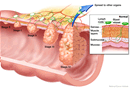 Colorectal cancer affects nearly 150,000 people annually. According to the American Cancer Society, it is third most common cancer and the second leading cause of cancer deaths among American men and women. This often silent killer has received tremendous attention in the media in recent years as the medical community and celebrities have joined together to remind the public of the importance of undergoing preventive screening to detect colorectal cancer in its earliest stages when it is most treatable. A baseline colonoscopy is recommended for men and women age fifty and older; however, individuals with a family history of colorectal cancer, or who are at risk for the disease due to other pre-existing conditions, should be screened earlier. There is no single cause of colorectal cancer, but it is thought that a high-fat, low fiber diet, rich in red meat, may increase risk. Cigarette smoking is a known risk factor for this condition. Early detection is critical to patient survival and the procurement of life insurance.
What Is Colorectal Cancer?
Cancer that begins in the colon, the six foot intestinal tract that connects the small intestine to the rectum, is called colon cancer. Cancer that begins in the rectum, an eight inch length of intestine that connects the colon to the anus, is called rectal cancer. Cancers affecting either of these organs may also be referred to as colorectal cancer. Colorectal cancer occurs when cells on the lining of either the colon or the rectum become abnormal, grow out of control and become cancerous. Nearly all colorectal tumors begin as non-cancerous (benign) polyps; certain types of precancerous polyps. called adenomatous polyps, may develop into cancer while hyperplastic polyps generally do not. Colorectal cancer occurs when there are mutations or errors in the genetic code that controls the growth and repair of the cells lining the colon.
Other related medical conditions (or medical terminology) include Colon Cancer, Colorectal Cancer, and Bowel / Rectal Cancer. Learn more information on receiving a term life insurance quote with these medical conditions from our life insurance specialists.
Know Your Risk for Colorectal Cancer
While anyone can develop colorectal cancer, it is most common among people over the age of fifty or in people who are at increased risk due to any of these conditions:
- Cancer elsewhere in the body
- Colorectal polyps
- High-fat, low fiber diet
- Inflammatory bowel disease (Crohn’s disease or ulcerative colitis)
- Family history of colorectal cancer or polyps
- Obesity
- Personal history of breast cancer
- Smokers
- Genetic syndromes known to increase the risk of developing colon cancer
Colorectal Cancer Symptoms and Screening Methods
Colorectal cancer may strike without telltale symptoms. For this reason, it is imperative to know if you are at risk. If you are at risk, your doctor will direct you to undergo screenings at scheduled intervals dependent upon your risk factors even if you are asymptomatic. Common symptoms of colorectal cancer include:
- A change in bowel habits (constipation or diarrhea)
- Blood on or in the stool that is either bright or dark
- Unusual abdominal or gas pains
- Unexplained weight loss
- Anemia
After a physical examination to palpate for tumors in the abdomen or rectum, and blood work, the physician may order additional diagnostic screening including:
- Fecal Occult Blood Test (FOBT): Usually performed in conjunction with flexible sigmoidoscopy, this is at-home test checks for blood in the stool that may be invisible to the human eye.
- Sigmoidoscopy: Performed every five years (in conjunction with FOBT), this test screens the sigmoid colon and rectum to detect polyps, tumors and other cellular changes; biopsies, tissue samples, can be performed during this screening.
- Colonoscopy: Performed every ten years, this test screens the entire colon and rectum; biopsies can be performed and polyps can be removed during this screening for lab analysis.
- X-rays: A barium enema, or lower GI, is a special x-ray series which utilizes a liquid, injected by enema, called barium sulfate which coats the colon and/or rectum lining so that clearer images of polyps and tumors are evident on x-rays.
Staging and Treating Colorectal Cancer
Once a diagnosis of colorectal cancer has been made, the cancer is “staged.” The system most often used is called the Dukes’ Staging system. Dukes’ Staging classifies a tumor according to how deep it has penetrated the colon or rectum lining and whether it has infiltrated the lymph nodes. Dukes’ staging classifications:
- Carcinoma “in-situ” – Cancer present in mucosa; no lymph node involvement
- Stage A – Cancer has penetrated to the submucosa; no lymph node involvement
- Stage B1– Cancer has penetrated to the muscularis; no lymph node involvement
- Stage B – Cancer has penetrated to the serosa; no lymph node involvement
- Stage C1 – Cancer has penetrated to the muscularis; lymph node involvement
- Stage C2 – Cancer has penetrated to the serosa; lymph node involvement
- Stage D – Cancer has spread beyond colorectal area (distant metastasis or spread of cancer)
Colorectal cancer treatment will vary depending upon tumor location, the level of infiltration of the lining and lymph node involvement. Treatment may include surgery, radiation therapy and / or chemotherapy.
The Impact of Colorectal Cancer on Insurability
When reviewing applications for life insurance, insurers will want clinical specifics, including Dukes’ Staging, from colorectal cancer applicants. Insurers are interested in the stage and grade of the cancer; the time elapsed since the date of the last cancer treatment; the type of treatment; and the frequency of medical follow-up. With the exception of diagnoses of colorectal carcinoma “in-situ”, which have favorable survival rates of 95 percent if treated immediately, most other diagnoses will have contingencies for acceptance – be it postponement for a period of time or premium rates for several years post treatment –accept in the cases of Dukes’ Stage D cancers which are typically incurable and options for insurance are limited to guaranteed issue or survivorship policies.
How Can MEG Financial Help?
At MEG Financial, we have worked with many individuals across the country that have had related histories and have helped many obtain fairly priced life insurance. A number of these clients previously attempted to buy life insurance elsewhere but were either turned down or asked to pay a significantly higher rate. Our experience helping others with related problems is invaluable to you in identifying the insurance company that will treat you most fairly.
For more specific information or to obtain a custom quote, call MEG Financial today at (877) 583-3955. You may also submit this short form and an independent insurance agent will personally contact you to go over any questions or other concerns.