
 Speak with an experienced advisor!
 Have you been declined for life insurance or been charged more because of a history of angina?
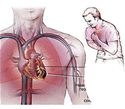 Angina or “heart related chest pains” can have a significant effect on your ability to qualify for life insurance. In fact, depending on the actual diagnosis, most life insurance companies will charge a substantially higher rate or even decline to offer coverage at all. If you have a history of angina, there is still a very good chance of being approved for life insurance at a reasonable rate. The information below will provide you with an overview of angina, its impact on life insurance rates and some helpful tips on ways to improve your chances of getting the best possible rate.
Angina Chest Pains Defined
According to the National Heart Lung and Blood Institute, Angina is defined as chest pain or discomfort that occurs when your heart muscle does not get enough blood. Angina may feel like pressure or a squeezing pain in your chest. The pain may also occur in your shoulders, arms, neck, jaw, or back. It may also feel like indigestion.
Angina is a symptom of coronary artery disease (CAD), which is the most common type of heart disease. CAD occurs when plaque builds up in the coronary arteries. This buildup of plaque is called atherosclerosis. As plaque builds up, the coronary arteries become narrow and stiff. Blood flow to the heart is reduced. This decreases the oxygen supply to the heart muscle and may result in angina. Angina is normally associated with exertion or it can be a result of emotional stress.
There are three types of angina: stable, unstable, and variant. The specific angina diagnosis will be a main factor in determining your rate for life insurance or if you are even insurable.
Stable angina. Stable angina is the most common and occurs as a result of the heart overworking. With stable angina there is a regular and predictable pattern of occurrence. The chest pains normally last only a few minutes and can be relieved with angina medication (usually nitroglycerin). The presence of stable angina increases your risk of a future heart attack.
Unstable angina. Unstable angina is a serious condition that requires immediate treatment. Unstable angina indicates that a heart attack could be imminent. It does not follow a predictable pattern and can occur without physical exertion and cannot be treated by rest or medicine.
Variant angina. Variant angina is very rare and usually occurs at rest. The pain can be severe and usually occurs between midnight and early morning. It is relieved by medicine.
Not all chest pain is considered angina. Chest pain or discomfort can be caused by other factors including a heart attack, lung problems (such as an infection or a blood clot), heartburn, or a panic attack.
Angina Statistics
According to the American Heart Association, in 2004, coronary heart disease (CHD) was the leading cause of death in America. Angina is a primary symptom of coronary heart disease.
- The actual number of deaths in 2004 related to CHD was 452,327 which accounted for nearly 20% of all deaths.
- Estimates are that 8,900,000 people in the United States suffer from angina.
- In 2004, there were 15,800,000 victims of angina (chest pain due to coronary heart disease), heart attack and other forms of coronary heart disease that are still living (8,500,000 males and 7,200,000 females).
- An estimated 400,000 new cases of stable angina occur each year. (Framingham Heart Study, National Heart, Lung, and Blood Institute)
Risk Factors of Angina Chest Pains
Angina in most cases is caused by risk factors that you can control. Life insurance companies are especially interested in these risk factors and how they impact each individual case. The following factors are most important in evaluating an individual’s coronary heart disease:
- Smoking or tobacco use history,
- Elevated Cholesterol levels,
- Obesity or Excessively Overweight. Body Mass Index (BMI) in excess of 25,
- Lack of exercise,
- Hypertension or High Blood Pressure,
- Diabetes,
- High Fat Diet or Poor Diet,
- Stress,
- Family history of CHD.
The Impact of Angina Chest Pains on Life Insurance Rates
Life insurance companies take a diagnosis of angina very seriously and will carefully scrutinize all medical records and lifestyle information before making any formal offer. Your health class we be established based on the information in your medical records including lab work, diagnostic tests and your physician’s notes. Diagnostic tests such as an EKG, Thallium Stress Test, Stress Echo or Angiogram are used by cardiologists to determine the type of angina present and the severity of the coronary heart disease. With this information, insurance companies can accurately evaluate your level of risk. Therefore, adequate follow-up with your cardiologist is very important to providing the insurer with the information needed to make you the best offer for life insurance.
A diagnosis of stable angina will definitely impact your life insurance rates, but will not preclude you from obtaining a reasonably priced policy. In most cases, stable angina is effectively managed with lifestyle changes and medications. Therefore, the more compliant you are with the recommendations of your physician, the greater the likelihood of securing a cheaper life insurance policy. For example, regular exercise combined with a low fat diet while maintaining a normal height and weight can reduce stress and work to control stable angina. The more stable your condition, the better your rate for life insurance. The best case scenario for an individual diagnosed with stable angina may be a standard health class with a select few companies. However, more than likely, most companies will offer a policy with an increased rate above the standard health class known as a rated or table rated health class.
Unstable angina is more difficult to insure as it cannot be controlled with medication and usually gets progressively worse over time. In many cases, with unstable angina, a heart attack is eminent. Therefore, most insurance companies will decline individuals with unstable angina. The keys to determining whether an individual with unstable angina is insurable are the results of the diagnostic tests described above. With very good diagnostic results and limited angina risk factors, there may be an opportunity to secure a policy but usually at a much higher table rated health class.
If you are diagnosed with angina and currently use cigarettes or other alternative tobacco products, you most certainly will be declined for life insurance. Smoking (or any other tobacco use) is a leading cause of heart related deaths and is definitely off limits if you expect to get life insurance with angina. If you were a smoker but have quit since your diagnosis this is considered very favorable by the insurance company and is an indication that you are serious about your health condition.
For more information on obtaining affordable life insurance with angina see, getting a lower rate on your life insurance with a history of angina.
How Can MEG Financial Help?
At MEG Financial, we have worked with many individuals across the country that have had related histories and have helped many obtain fairly priced life insurance. A number of these clients previously attempted to buy life insurance elsewhere but were either turned down or asked to pay a significantly higher rate. Our experience helping others with related problems is invaluable to you in identifying the insurance company that will treat you most fairly.
For more specific information or to obtain a custom quote, call MEG Financial today at (877) 583-3955. You may also submit this short form and an independent insurance agent will personally contact you to go over any questions or other concerns.